Showing posts with label Prophecy. Show all posts

Tuesday, March 23, 2010

Prophet for hire: part 1

But Balaam answered and said to the servants of Balak, "Though Balak were to give me his house full of silver and gold, I could not go beyond the command of the LORD my God to do less or more.”

Numbers 22:18


donkey (4 years) The story of Balaam is an interesting one, and not just because of the part of the story where his donkey speaks to him. It is a crucial story because it is clear that regardless of his past practices, Balaam 1) knows he has heard from the true God on this matter, and 2) claims some level of commitment to being faithful to God’s Word. This is seen in his statement that he cannot say “less or more” than what God has given to him. It is seen in his claim that to “the LORD my God.”


But Balaam is a study in decline. His firm resolve that no amount of money could persuade him to curse Israel if this was not God’s command begins to wilt in the repeated offers from Balak. Eventually he caves in, at least to meet with this rich patron who believes Balaam has the power to curse an entire nation. But even then, God has a bigger plan at work. The reluctant “prophet for hire” will still be used to get Balak’s attention and to witness to the greatness of what God is doing with His people Israel.


Balaam, however, would eventually be undone by these slow accommodations to greed.  He is known in future generations as a false prophet who loved to gain from wrongdoing (2 Peter 2:15). He would eventually die under the later conquest of Canaan because his advice to Balak resulted in Israel falling to prostitution and idolatry.


The lesson of Balaam is that little choices can lead to major slides from truth and from commitment to God. Balaam was a pagan oracle who had a brief dramatic encounter with the true God, only to fall away into materialistic greed and be judged by God. He serves forever as a warning to be true to God’s message, no matter what tempts us away.


Wednesday, October 21, 2009

malignant ministry as the call of God.

destruction of the temple

Thus said the LORD my God: "Become shepherd of the flock doomed to slaughter.”

Zechariah 11:4

This chapter is a difficult one to understand. There are metaphors and symbols within a large extended parable. Zechariah is asked to shepherd some stubborn sheep in the midst of some careless, foolish fellow-shepherds. There is no literal event being talked about. It is very hard to draw lines of interpretation from this complicated parable. Interpreters are all over the board on what is going on in this passage. But one thing is clear: God may call good people to work in difficult, dangerous, even unfruitful fields of ministry. Zechariah experiences no “success” in this endeavor, at least in terms of the response of the “sheep” and the “shepherds”. Both go bad and leave him with nothing but anger and anguish at his involvement with them (Zechariah 11:8-9). About fifteen years ago, I know I was there brutally for about six months. I was not a good guy at that time. It ain’t any fun!

I think that in terms of staying within the broader context of the book of Zechariah, it is good to see the prophet “acting out” the role of the Messiah and his eventual rejection. This is the interpretation that John MacArthur proposes for this chapter, and as I look at it further, it fits. The Messiah’s rejection is part of Old Testament prophecy (Daniel 9:26-27). And this does fit the way in which Jesus Himself predicted His rejection and the subsequent destruction that would befall Jerusalem at the destruction of the temple (Matthew 24:1-2). The final puzzle piece that fits this is the whole thirty pieces of silver description here (Zechariah 11:12). The New Testament gospel writers pick up on this as the blood price for Jesus with the prophetic details emphasized (Matthew 26:14-16).

Jesus would be called to difficult ministry. And he would ultimately be rejected by those to whom He came. The Roman authorities that carried out His execution at the desire of those shepherds in Israel that had rejected Him would later complete their oppressive rule by destroying Jerusalem and the temple worship a generation after Jesus’ death and resurrection. And Zechariah acted out the key points in this drama as the exiles returned from Babylon centuries before these events.

Technorati Tags: ,,

Thursday, October 15, 2009

God’s ongoing love for His people

star of david Thus says the LORD of hosts: behold, I will save my people from the east country and from the west country, and I will bring them to dwell in the midst of Jerusalem. And they shall be my people, and I will be their God, in faithfulness and in righteousness.

Zechariah 8:7-8

This promise began to be fulfilled with the return of the Jews from Babylon and the slow resettling of Jerusalem. But God saw something much bigger than they were experiencing. He saw a city that was bustling with activity… a true metropolis filled with Jews who feared and followed Him. The Jerusalem of Zechariah and his contemporaries was more like a small frontier town. It had not fully re-established itself. That is why this promise came.

Of course, by the time of Jesus, Jerusalem was again an urban crossroads. It was so strategic that the Romans stationed troops there and administered its affairs. After Christ’s ascension, during the Feast of Pentecost, it was a world crossroads so cosmopolitan that the apostles were able to reach a cross-section of the entire Roman World and Near East with just one sermon in Acts 2. And despite two millennia of ups and downs, wars, occupations, and day-to-day life, Jerusalem is still at the center of attention for many in my world. It is a city holy to three major world religions. And it is still loved by God.

I pray for the peace of Jerusalem. The scriptures call us to do so. But I know that one day the Prince of Peace will fully rule from there. It remains a holy city, though with all the conflict and bombing, I’ll hold off my visit until Jesus takes over (see Daniel 7:13-14; Revelation 20:4).  Until then, and I mean this, you gotta love the Jews! God does!

Technorati Tags: ,,

Wednesday, October 7, 2009

A Deliverer is coming.

up a tree Hear now, O Joshua the high priest, you and your friends who sit before you, for they are men who are a sign: behold, I will bring my servant the Branch.

Zechariah 3:8

The reality of this verse is that God is promising the exiles who are returning to Jerusalem that a great Deliverer is coming. This is a Messianic promise. It calls the Messiah “the Branch”, hearkening back to Jeremiah’s pre-exilic words of prophecy. And the Deliverer comes as a servant to the nation.

The scene in which this promise is made reads like the kind of thing recorded in the epic poetry of Job. Joshua (or Yeshua – Greek: Jesus) is the high priest who has returned to Jerusalem to re-institute temple worship. (Zechariah 3:1-3) We also read about him in Ezra and Nehemiah. In this vision, Zechariah sees the priest standing before the angel of the Lord, with Satan standing to the right of him, accusing him before the Lord. And God rebukes the devil. It seems that Satan is wanting to accuse Joshua of being unfit to be a priest. He is clothed in filthy garments. And God just takes care of that. (Zechariah 3:4-5)

The rest of chapter three is an address to the high priest in which God assures him and comforts him.(Zechariah 3:6-7) He promises that if Joshua will walk in His ways, God will bless the work of his priesthood. And then God re-affirms the promise to bring His servant, the Branch to the nation. The faithful nation, restored to its land, worshipping the Lord, would eventually see the Messiah come. This is still hundreds of years away, but to Joshua the high priest is given the promise of Jesus, the Great High Priest. And after that promise, God paints a beautiful picture of peace under the rule of Branch (Zechariah 3:9-10)

To the first post-exilic high priest that also bore Jesus’ own name, God gave the promise of the Messiah. He affirmed this priest with a promise. He removed the iniquity of that priest to show that God could use someone for His purposes. He assured the nation of His unfailing love and power to forgive. And He promised a future… one that I know today, yet still anticipate in its completion.

Technorati Tags: ,,

Thursday, June 11, 2009

A Big God in a Big World.

For from the rising of the sun to its setting my name will be great among the nations, and in every place incense will be offered to my name, and a pure offering. For my name will be great among the nations, says the LORD of hosts.

Malachi 1:11
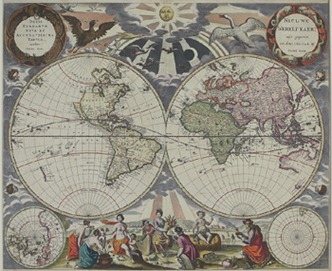
old maps

Two distinct observations come to me from this first chapter of Malachi. The first has to do with the overwhelming use of the phrase “Lord of hosts” throughout this small prophetic book. Why does this description of God overshadow and emphasize the message of this book? It is used in this little book more than any other OT Book. Look…

Lord of Hosts

The ESV Study Bible provides some insight:

In the postexilic period of Malachi, the postage-stamp-sized Judah, as a tiny province within the vast Persian Empire, had no army of its own. It is precisely in such times, when God's people are painfully aware of how limited their own resources are, that there is no greater comfort than the fact that the Lord has his invincible heavenly armies standing at the ready. It is like the comfort that Elisha prayed for his servant at Dothan when they were surrounded by the Syrian armies: “‘O Lord, please open his eyes that he may see.’ So the Lord opened the eyes of the young man, and he saw, and behold, the mountain was full of horses and chariots of fire all around Elisha” (2 Kings 6:17). Perhaps it is like the comfort felt by Jesus before the cross: “Do you think that I cannot appeal to my Father, and he will at once send me more than twelve legions of angels?” (Matt. 26:53).

God was using this description to comfort a nation that had all its securities ripped away. They still had their problems. Their worship was stale, not from the heart, ritualistic, and only going through the motions. But they needed to know God was on their side. He is a big God… the Lord of the hosts of heaven’s armies.

The second observation has to do with the phrase at the beginning of Malachi 1:11. What significance does this description of the rising and setting and sun have to the context of Malachi? Again, the ESV Study Bible provides some clear exegetical insight…

Surprisingly, Malachi refers to the presentation of incense and pure offerings in many places, even among the nations, rather than exclusively in the temple in Jerusalem as Deuteronomy 12 requires (cf. Mal. 3:3–4; 4:4). A key to this controversial verse is to recognize that from the rising of the sun to its setting is standard predictive language regarding a future age of great blessing (e.g., Ps. 50:1; 113:3). Isaiah 45:6 and 59:19 include with this phrase a reference to the ultimate engrafting of the nations, suggesting that a similar meaning is implied in Malachi. This finds further definition in such texts as Isa. 19:19–25 and 66:1–21, where the nations will be made to be “Levites” and will offer acceptable offerings on approved altars to the true God. For the engrafting of converted Gentiles into Israel, cf. Ruth 1:16–17; Est. 8:17; Psalm 87; Isa. 56:6–8; Zech. 2:11; 8:23

The last phrase has a twist of Covenant Theology in it, but I am going to let the discerning person deal with that. It is clear that Gentiles are “grafted in” to God’s plan to call a people to Himself (see Romans 9, 10, 11). So in this last book  of the OT canon, God left clear indicators that He was reaching not just Israel, but the world. Malachi really does serve as a fitting bridge to the New Testament in many ways. This is just the first observation I will make about that bridge.

Technorati Tags: ,

Wednesday, May 20, 2009

The Burden of Prophecy.

scroll

And I was told, "You must again prophesy about many peoples and nations and languages and kings."

Revelation 10:11

When John is again instructed to write down words of prophecy, it is after an event is recorded in which specifically “seals up” some of the detail so that it might not be known. God does the revealing in the book of Revelation. He chooses when it is best to say it as well. And John learns this at this time.

When God sets John free to record again, there is this symbolic moment where an angel instructs him to eat a scroll (yum… fiber). In his mouth it is sweet as honey, but once it hits his stomach, it turns bitter. A little divine nausea comes with the preaching of God’s Word. This is the picture of the burden of prophecy.

Carrying God’s truth and proclaiming it are instantaneously sweet experiences and also painful realities. It is both dessert and indigestion, all at the same time! I have felt this sort of feeling at times with a Sunday message that I knew was particularly needed, but also hit me square between the eyes. And I think, that as John prepares to “again prophesy”, that feeling has hit him in the pit of his gut. And only the faithful reporting of God’s Word will relieve his condition.

Technorati Tags: ,,