Showing posts with label Stewardship. Show all posts

Monday, January 18, 2010

God and money.

burning money

No servant can serve two masters, for either he will hate the one and love the other, or he will be devoted to the one and despise the other. You cannot serve God and money.

Luke 16:13

Divided loyalties will not advance the kingdom of God. Jesus makes it clear that a commitment to a life serving God cannot also be a life committed to an agenda of worldly wealth. The two are incompatible. Jesus is not saying that money is evil. If you look into the context, it is clear that He is talking about the attitude we have toward material things. We must see them as resources for a higher goal and end.

He begins with our motivations, letting us in on an important big picture truth… money is often used in this world to gain status and security. The parable of the dishonest steward (Luke 16:1-9) has a central theme: money is often used to gain intangible results. If that is the case in worldly pursuits, why not manage it toward the ultimate leverage: eternal impact and reward?

Principles of wise “eternal” investment are then explained by Jesus (Luke 16:9-13). He expects His followers to find this appealing. And He expects us to seek reward not from a dividend alone, but from the God Who gives us all we have to utilize for His glory.

The Pharisees mock Jesus for teaching these values (Luke 16:14-18). Their motive was selfish in all relationships and responsibilities. They were moved by the love of money. Jesus calls their materialistic motivation an abomination in the sight of God. He does not mince words. He cannot see materialism leading to obedience to God. Those who serve money as their life’s worship are not able to worship God as evidenced by the Pharisee’s inability to receive or believe this truth. They are in conflict with His eternal kingdom. And that cannot end in eternal life for them.

That leads to the most difficult part of the teaching in Luke 16. Jesus tells the story of the Rich Man and Lazarus (Luke 16:19-31) to make one essential and brutally clear point: all the money in the world will not buy your soul out of hell. God will not barter with either bankers or borrowers in eternity. It is of no interest to Him what you had. It is of all the interest to Him what you did for Him with what you had. He gave it to you. In the end, it is better to be a beggar in heaven than a billionaire in hell.

Tuesday, September 1, 2009

Finishing to blessing.

According to all that the LORD had commanded Moses, so the people of Israel had done all the work. And Moses saw all the work, and behold, they had done it; as the LORD had commanded, so had they done it. Then Moses blessed them.

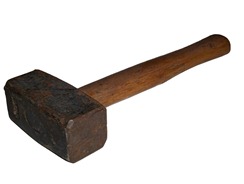
Exodus 39:42-43sledgehammer

There is a modern proverb: “Hard work is its own reward”. That is not necessarily the case. Many people work hard throughout the world with nothing but pain to show for it. I watched a report on 60 Minutes Sunday night that showed the hardships “recyclers” pay in China. They live in filthy slums on the recycling plant. Harsh toxic chemicals from the computer CRT screens that get sent there to be recycled pollute their homes and drinking and bathing water. They are covered in sores from chemical burns received at the plant as they breakdown TV monitors and computer equipment. They work hard. Their children suffer in the slums they live in. And they receive enough pay to buy a little rice and that’s about it. The US and European companies that send the technology to China to recycle taut it as saving the planet. It is killing people. So much for green jobs.

But hard work for the glory of God is a different matter. It is blessed by God. In this passage Moses saw all the detailed final product of the work to build the tabernacle and its furnishing. And Israel obeyed God to the last detail of the construction. It was pleasing to God. It was hard work, but it was blessed. They obeyed and God was pleased through their leader.

Blessing in ministry is important. Many times churches ask people to work hard behind the scenes. It takes a lot of that kind of work to make the kingdom of God what it is in this world. The metaphor of the New Testament is that the church is God’s building built of many stones. Some are elaborate pillars readily seen. Others are foundation stones buried under the floor that hold it up. But every stone is needed, and is to be celebrated because we are “living stones”. I am so thankful for the scores of people who serve the Lord in my church! They make the ministry such a joy and blessing. May God bless His Church through all the efforts each of us makes in service to the kingdom. One day we will all stand before Him in the glory of His presence. And we want to finish well. We want the joy of His simple blessing to us: “Well done, my good and faithful servants.”

Technorati Tags: ,,

Monday, August 10, 2009

Give me oil in my lamp, keep me burning

"You shall command the people of Israel that they bring to you pure beaten olive oil for the light, that a lamp may regularly be set up to burn. In the tent of meeting, outside the veil that is before the testimony, Aaron and his sons shall tend it from evening to morning before the LORD. It shall be a statute forever to be observed throughout their generations by the people of Israel.

Exodus 27:20-21

olive-oil-bottle-2 In the midst of a long list of supplies and an elaborate blueprint for the construction of the tabernacle, Israel is instructed to donate the simplest and most common of household resources for the worship of the Lord. An oil lamp would be built, and kept burning before the Lord’s presence. And Israel would provide the olive oil to fill its reservoir. This was a contribution any Israelite could make to the worship of the Lord.

God delights in both the common sacrifice, and the wildly generous gift. Gold and silver are nice. Exotic skins for the tabernacle tent and highly crafted textiles for the curtains were only one part of the supply list. Other materials were readily available in the home of any family among the camp. And the olive oil was the simplest and most available for ready supply (though perhaps only through trade at the time of the desert wanderings).

I like the thought that individual families could all donate some olive oil, and that this was kept in a common supply. Did the oily gifts of all the different families mingle into one common supply jar, or did individuals drop off a daily ration so that it was always fresh? Either way, each family could have contributed their own part of what became the flame the burned before the Lord. There are no insignificant gifts. Poor families might think, “Maybe I have no gold, but I do have cooking oil. I can give that!” And God will be worshiped with that.

In a time of economic thrift, Joni and I have begun to feel huge sacrifices with our increasingly smaller gifts. There was a time in my life (about a decade ago) when we could routinely give away nearly a quarter of our income and not feel challenged by it. But the kids have grown into really hungry teenagers, inflation has grown, cost of living increases (it never decreases),  and unanticipated medical expenses have shown up as we have aged, even as salary has shrunk. And now to give even the simplest of gifts to the work of the Lord is felt. To give over and above a simple amount feels impossible (even though I know it is what we should do if God has asked it of us).

The lesson of the olive oil is that there are no small gifts. And I take comfort in that. In the past we have easily been able to provide much larger gifts. But for whatever reasons, God has placed us in the olive oil category for now. I know that we can provide those sort of things, and as we sacrifice further, we can find God helping us to be generous in many small ways with what we have been blessed to share. And that is really the whole point of the matter. It humbles my pride. If all I have left is olive oil, will I see it as an item with which I have been blessed in order to share in ministry and worship God? The choice is mine. I can see the present circumstances as an economic downtown and lock away my chances to serve God with what we do have. Or I can see it as a challenge to find new ways to be generous in my worship of the Lord. I really believe God is asking me to grow during this time to practice the “olive oil” alternative.

Technorati Tags: ,,,

Tuesday, April 28, 2009

Giving where it is due.

denarius

Then he said to them, "Therefore render to Caesar the things that are Caesar's, and to God the things that are God's."
Matthew 22:21b

Tax day was just a couple of weeks ago, but this passage still rings with vital meaning. I have been serving in ministry as my primary means of vocation for over twenty years now. And historically, April is always a low month for giving to the church... I suspect because Uncle Sam comes calling. And I feel the tension.

The past four years have seen a downturn for my own personal ability to give. I used to enjoy giving substantially to the church and missions (at times nearly a fourth of my income). But 2005 found seminary obligations decreasing that amount. That lasted through last year. And then has come this vividly hard year of 2009, where medical bills have piled up... dental work... unanticipated surgery for one child... orthodontics in the future for another child... and suddenly it is very hard to find the means to give generously.

But the thing that convicts me is that I still render to Caesar. They throw you in the Big House if you decide not to do that! Now, I am in a VERY LOW tax bracket (another outcome of ministry), but even at that, this year it appears that my rendering to Caesar will be more than my giving to God. That is a first for us.

My desire is by the end of third quarter 2009, to have paid off medical debts to the point where we can restore generosity to the work of God. In addition to this, I am praying for God to somehow supply some additional summer income, so this might happen sooner. My heart is to follow Jesus' clear command.

Thursday, April 23, 2009

Eye of the Needle

eye of the needle

And Jesus said to his disciples, "Truly, I say to you, only with difficulty will a rich person enter the kingdom of heaven. Again I tell you, it is easier for a camel to go through the eye of a needle than for a rich person to enter the kingdom of God."
Matthew 19:23-24

This passage if often preached poorly. It has been used to harangue those who are wealthy. That was not Jesus' point. Yes, the rich young man in this account could not let go of his wealth. But that does not mean all those with wealth are doomed to hell for materialism. Jesus makes the point that riches add "difficulty" to a rich person's ability to follow Him. This is certainly evident in the case at point in the account. But Jesus also had wealthy followers. Nicodemus was a wealthy and influential man who eventually chose to give it all up for Jesus at His death. So was Joseph of Arimethea.

And there is evidence in the book of Acts that riches and influence do not force folks away from the kingdom. The Ethiopian eunuch had both wealth and political power. Lydia was a wealthy women. Aquila and Priscilla seemed to own a thriving business. In Romans, Phoebe is mentioned as a servant of the church, and she seems to have some means to support Paul's ministry. So wealth is not the issue, it is the heart's attitude toward it. And the reality is that some wealthy people refuse to be enticed away from the real issues. They can follow Jesus, with difficulty. So do those of us who live paycheck to paycheck!

Technorati Tags: ,,